C-Suite Insights Header

Welcome back, readers! In this week’s newsletter (a 5-minute read), we’re giving you timely insights on:

  • C-Suite priorities for 2027
  • Celebrating leadership in innovation
  • The consumer confidence rebound
  • Free enterprise and economic opportunity
  • Leading in the AI era
  • Retirement security and longevity
  • Anticipating risks and disruptions
  • The changing shareholder activist playbook
  • Building AI-ready marketing teams

View Last Week's Insights

writing

C-Suite Outlook Survey

Take Our Annual C-Suite Outlook Survey

For nearly three decades, C-Suite Outlook has captured the pulse of global business—revealing the priorities, challenges, and opportunities shaping executive strategy.

We’re inviting C-Suite executives to share their insights for the 2027 edition of this benchmark report. Your perspective helps guide leaders worldwide.

The survey closes November 6. If you're a member of the C-Suite, take 5 minutes to share your perspective.

Start the survey now »

analytics

Economy, Strategy & Finance

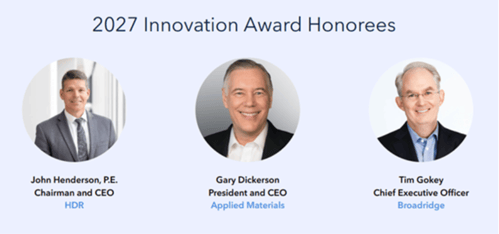
Announcing the CEO Honorees of the Inaugural 2027 Innovation Awards

image (93)

The Economy, Strategy & Finance Center of The Conference Board is honored to announce the CEO recipients of the inaugural Innovation Awards. These leaders and their firms will be recognized at a special awards dinner on January 19, 2027, in New York City.   

The 2027 honorees exemplify organizations at the vanguard of making innovation a core element of business strategy using technology, data, and new ideas to improve operations, better serve customers, strengthen resilience, and create enduring value at scale. 

This year’s recipients are:

  • Tim Gokey, Chief Executive Officer, Broadridge

  • John Henderson, P.E., Chairman and Chief Executive Officer, HDR

  • Gary Dickerson, President and Chief Executive Officer, Applied Materials 

Why it matters: “Innovation is no longer a discrete initiative; it is central to how organizations prepare for change, make investments, and create long-term value,” said Dana M. Peterson, Chief Economist of The Conference Board. “Broadridge, HDR, and Applied Materials demonstrate the kind of leadership required to turn new thinking and possibilities into meaningful business progress. We are proud to recognize how their work is strengthening systems, infrastructure, and technologies that move the economy forward.” 

Read »


US Consumer Confidence Increased in October

The Conference Board Consumer Confidence Index® rose by 7.5 points to 91.7 (1985=100) in October, up from 84.2 in September (a slight upward revision). 

The Present Situation Index increased by 8.6 points to 120.4. The Expectations Index— based on consumers’ short-term outlook for income, business conditions, and labor market conditions—recovered by 6.9 points to 72.6.  

Revived confidence—with caveats: Overall, confidence revived to June 2026 levels in October, as retail gasoline prices eased compared to last month. Views of current business conditions swung back to positive, and expectations for future conditions and job availability became less negative. 

Despite the upsurge in October, consumer confidence remained on the long-term downward trend that’s persisted over the past few years. Consumers planned less spending on services and durable goods over the next six months, likely reflecting higher price levels and increased inflation.   

In short: Consumer confidence advanced in October, driven primarily by improved perceptions of both current and expected business conditions. Nevertheless, October’s recovery only partially reversed three consecutive monthly declines. 

Read »

tarifftrackerbanner - updated
people

The CEO Center

Americans Continue to Support Free Enterprise over Socialism

Americans continue to support free enterprise, even as support for socialism grows. According to Gallup, 77% view free enterprise positively, compared with 43% who view socialism positively. Small businesses enjoy even stronger support (95%), while just 35% view big business positively.

Why it matters: Americans still embrace entrepreneurship, competition, and innovation, but growing doubts about whether economic opportunities are accessible to everyone could discourage business formation, weaken talent pipelines, influence consumer loyalty, and undermine US competitiveness.

The TCB take: Business leaders have a role in rebuilding confidence by making economic opportunity more accessible. Expand entrepreneurship education and work-based learning, mentor aspiring business owners, and help connect them with capital, professional networks, and resources. Demonstrating that free enterprise can continue to create opportunities for more Americans is essential to sustaining innovation, economic mobility, and long-term growth.

Read »

group-1

Human Capital

AI Is Reshaping Work and Redefining What It Means to Lead

AI is changing how quickly work gets done, but leadership structures and skills are struggling to keep pace. Nearly two-thirds of surveyed leaders (64%) say AI is already used across several functions or highly integrated into daily work, yet 37% report unclear or inconsistent accountability for AI-related decisions.  

Why it matters: AI is creating new management bottlenecks, increasing the volume of work leaders must review, and challenging traditional leadership structures. Nearly 4 in 10 leaders (38%) anticipate fewer middle managers, while 52% rank critical thinking and decision-making as the most important enduring leadership skill. 

The TCB take: Companies need to rethink leadership for the AI era. Clarify decision-making authority, experiment with more flexible leadership models, and redesign workflows around human-AI collaboration. Invest in hands-on, role-specific training that strengthens judgment, critical thinking, coaching, and other human capabilities. Above all, ensure AI-driven speed doesn't come at the expense of quality, accountability, or employee development. 

Read »

quotation

Quotable

How to Build Retirement Income That Lasts_ Prudentials Phil Waldeck
“Retirement security is one of the defining themes of our time. As longevity is increasing, and as a significant population moves into retirement, this matters more not only for individual lives, but for our economy and for society more broadly.”

Phil Waldeck
Head of US Businesses
Prudential Financial

Listen to the episode “How to Build Retirement Income That Lasts.”

lightbulb icon

New Tool

Which Risks Should Be on Your Radar?

Monitor recession signals, economic vulnerabilities, and unexpected high-impact events. Data Central helps organizations assess potential effects across regions and industries and bring external intelligence into scenario and contingency planning. 

Explore risk and scenario-planning tools »

myTCB email icons-sustainbility

Governance & Sustainability

Shareholder Activism Is Evolving—and No Company Is Immune

Shareholder activism is becoming more concentrated and strategically focused, even as campaign volumes fluctuate. In 2026, activity slowed seasonally in the third quarter but remained broadly in line with multiyear averages. Activists are increasingly targeting larger companies, including those once considered less vulnerable because of their size or regulated status. 

By the numbers: M&A was a focus of 58% of global activist campaigns in 2026, while 82% of campaigns were concentrated in five sectors: industrials, technology, consumer, healthcare, and financial services. 

What’s changing? Activists are using AI to conduct deeper, faster financial analysis—raising the bar for companies to demonstrate the measurable impact of their strategies, capital allocation decisions, and AI investments. Settlements remain the primary path to board representation, while a fragmented voting and shareholder-engagement landscape is making year-round investor dialogue essential. 

The TCB take: Lower campaign volumes should not be mistaken for lower risk. Boards should assess vulnerabilities before an activist does, maintain a credible strategy supported by clear metrics, and understand the evolving expectations of their full shareholder base. 

Read »
Produced in partnership with Cleary Gottlieb

marketing1

Marketing & Communications

AI Opens New Career Opportunities in Marketing, Including for Nontraditional Talent

AI is reshaping marketing teams. It is creating opportunities for more strategic work, including for less experienced talent, while changing the skills, roles, and leadership approaches needed to succeed. At our recent roundtable, marketing executives discussed several emerging trends:

  • AI adoption barriers remain. Fears of AI-driven job replacement, stigma around AI use, and ethical and environmental concerns require clear leadership communication, practical training, and demonstrated AI-driven value.

  • Team structures are evolving. AI is increasing demand for technical expertise and collaboration and reducing entry-level roles. Internal AI champions can help colleagues integrate more advanced AI applications.

  • Human thinking gains importance. As AI handles routine work, that makes creativity, strategic thinking, and judgment more valuable. Recruitment may increasingly favor these capabilities, including among candidates from nontraditional backgrounds.

  • Talent development needs rethinking. Junior marketers can contribute to strategic work earlier, but they need hands-on coaching to develop independent thinking and the ability to critically evaluate AI output.

The TCB take: Marketing leaders need to look beyond AI-driven efficiency toward redesigning work and developing talent. The opportunity is to elevate employees' contributions through AI while strengthening the human capabilities that make AI valuable. 

Read »

CEO-banner-1_CTA

TCB-Torch-Blue1 Terms of Use | Privacy Policy | Event Code of Conduct | Trademarks
© 2026 The Conference Board Inc. All rights reserved. The Conference Board and torch logo are registered trademarks of The Conference Board.
The use of all data from The Conference Board data and materials is subject to the Terms of Use. Reprint requests are reviewed individually and may be subject to additional fees. The Conference Board reserves the right to deny any request.